Can You Install an Egress Window in a Calgary Winter?
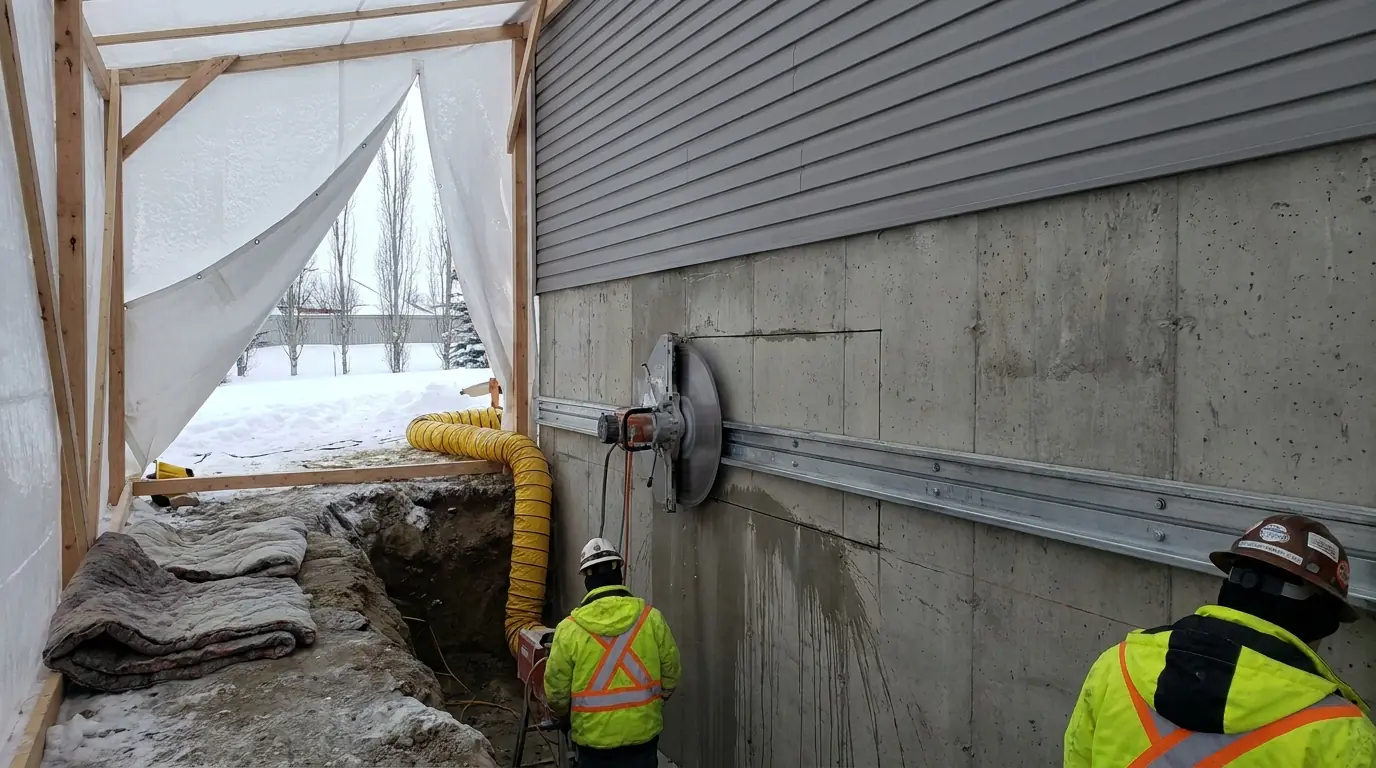
You can. A diamond saw works the same in February as it does in August.
That deserves saying clearly, because many Calgary homeowners hear “wait for spring” from companies whose real meaning is “we prefer spring.” One is a technical limit and the other is a preference.
The fuller picture is that winter does change some parts of a basement window installation, and being honest about which parts serves you better than either pretending the season does not matter or turning the job down.
The concrete cutting works year-round
A diamond wall saw cuts cold concrete just as it cuts warm concrete. The blade grinds through stone aggregate and rebar, and cold weather does not change how either responds in any way that matters.
If anything, cold concrete is marginally kinder to a blade than hot concrete. That is too small a difference to bring up as a benefit, but it does put to rest the idea that cutting is the part tied to the season. It is not.
The seasonal parts are the ones that involve digging into the ground or handling water.
Frozen ground slows the excavation
Frost is the true winter difference, and it makes digging slower rather than impossible.
The frozen crust has to be broken before normal digging can begin. Depending on how cold the winter has been, how exposed that side of the house is and how much snow cover has insulated the soil, the crust may be minor or it may be the toughest task of the day. Expect extra equipment, extra hours or both.
Where a machine can reach the wall, that is a manageable extra step. Where the dig is by hand on a narrow lot reached only from the lane, with fences and utility lines in the way (a common situation in the inner city), frost becomes a much larger factor, since chipping frozen soil by hand is slow going.
A fair rule of thumb, then: installing an egress window in winter is entirely realistic, and more so at houses where equipment can get to the foundation.
Winter has genuine upsides
Two aspects of the job actually improve in cold weather, and we are not saying so to sell anything.
Frozen soil stays put. A spring dig in wet Calgary clay can turn into mud. The same yard in February is solid, the excavation keeps its walls, and far less mess ends up on the lawn and tracked indoors. On soft or sloped lots that can decide whether the site stays neat or gets torn up.
Calendars have space. Enquiries for basement windows rise and fall with the seasons even though the work itself does not need to. Winter is when crews have openings.
Timing helps too. If you plan to finish the basement in spring, getting the opening cut, the new window installed and the inspection done over winter means your framers and drywallers are not stuck in the spring permit queue with everyone else. How to sequence that is covered in how long an egress window takes.
Water is what needs careful handling
Wall saws cut wet. Water keeps the blade cool and flushes out slurry, and in cold weather that water freezes: on the foundation, in the hole, over any surface it reaches, and as an icy patch on the path someone walks early the next morning.
Dealing with it comes down to containing, collecting and cleaning up the slurry, nothing unusual, but it is a real part of running a tidy winter site and a reasonable thing to ask any installer. Asking what happens to the slurry in January quickly shows which crews regularly work through winter and which are trying it for the first time.
Sealing is the other water issue. Window sealants, spray foams and membranes all come with manufacturer temperature limits for application and curing. Use them outside those limits and the seal may look complete without actually being so. Cold-rated products are available and in regular use; what matters is choosing materials for the conditions on the day rather than grabbing the same ones used in summer.
A spring surprise worth planning for
This is the winter-specific risk that rarely gets mentioned, and it is why the choice of installer matters more than the choice of season.
Soil backfilled against frozen ground, or soil that contains frozen clumps, does not compact as it would in summer. Once it thaws, the gaps collapse, and the ground over the new window well can sink, sometimes visibly.
Two things can follow. A low spot can form along the foundation, directing water toward the house instead of away from it. And the window well itself can shift a little as the soil around it moves.
None of that rules out winter work. It simply means backfill and grading should be handled with care, and you should discuss whether final grading and yard restoration happen immediately or after the thaw. For many winter installs the right approach is to restore the ground properly in spring, and your contract should state that plainly instead of leaving it for you to find out.
Raise the question. If an installer says nothing changes in winter, keep looking.
Projects where winter weighs more
Deep excavations, exterior stairwells and walk-out basement doors are more affected by the season than a window well, because they involve more soil and more depth. Installing a walk-out doorway in January is a bigger decision than adding an egress window in January, and at some houses waiting really is the better advice.
At any property, if the soil beside the wall was soaked before it froze, we want to see it before booking a date.
In short
Concrete cutting is not affected by the season. Digging takes more effort, slurry water needs managing, sealants must suit the temperature, and backfill deserves extra care. In return you get stable ground, a cleaner site and more scheduling flexibility.
Send us your address and we can say if your foundation suits a winter install or a spring one. We are happy with either; the what actually moves the cost page covers which parts of the price the season affects and which it leaves alone.
Planning a basement window or door?
Tell us what the room or the entrance has to do, and we will come out and look at the wall itself. We work across Calgary, Airdrie, Cochrane and Okotoks.